
Artificial Grass Backing Systems: Polyurethane vs Latex
Quick Answer
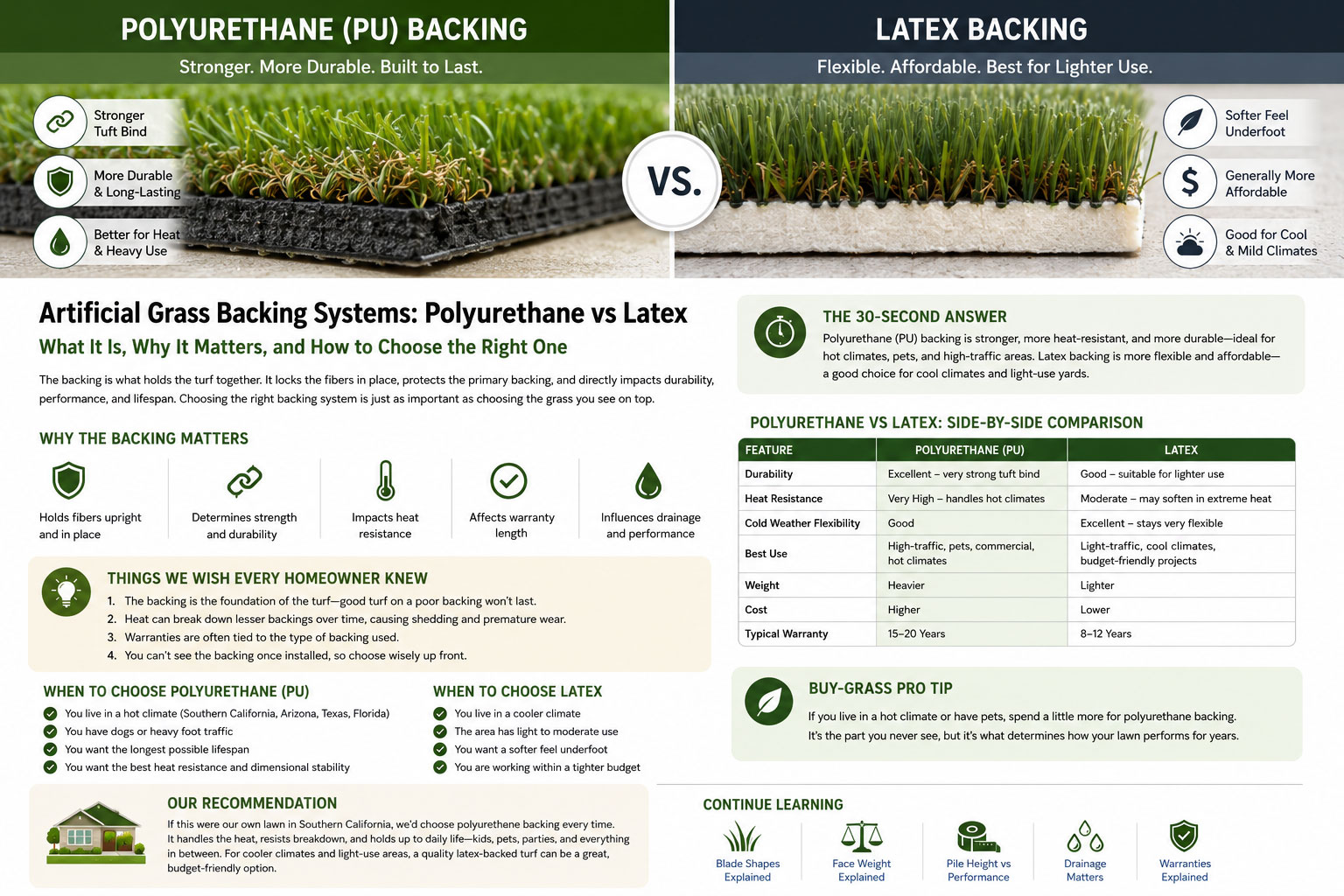
If durability, heat resistance, pets, or heavy use are priorities, polyurethane backing is usually the better choice.
Latex backing is more flexible and often less expensive, which can make it a reasonable option for lighter-use installations and cooler climates. But for many residential projects—especially in hot regions—polyurethane offers stronger long-term performance.
The key is not to judge turf by the grass blades alone. The artificial grass backing underneath is what helps hold the entire product together.
Why Artificial Grass Backing Matters
When homeowners compare synthetic turf, most attention goes to the visible part of the product: color, softness, pile height, blade shape, and density.
That makes sense. Those are the features you can see and touch.
But the backing is doing much of the structural work.
The backing system helps secure thousands of individual turf fibers, gives the product dimensional stability, affects drainage, and contributes to how well the turf handles heat, moisture, foot traffic, pets, and years of outdoor exposure.
Once the turf is installed, you may never see the backing again. That is exactly why it is worth understanding before you buy.
Buy-Grass Pro Tip
A beautiful turf sample can hide a mediocre backing. Before deciding that one product is “premium,” turn the sample over and ask what actually holds the fibers in place.
What Is Artificial Grass Backing?
Most artificial grass uses more than one backing layer.
The primary backing is the woven material through which the turf fibers are tufted. A coating is then applied to the underside to help lock those fibers into place and stabilize the product.
That coating is commonly made from either:
- Polyurethane
- Latex
Both systems can work well when properly manufactured. The difference is how they behave under different conditions.
Polyurethane vs Latex: Side-by-Side
| Feature | Polyurethane | Latex |
|---|---|---|
| Durability | Excellent | Good |
| Heat Resistance | Very good | More sensitive to prolonged heat |
| Flexibility | Moderate | Very good |
| Heavy Traffic | Excellent fit | Better for lighter use |
| Pet Areas | Usually preferred | Can work depending on system |
| Hot Climates | Strong choice | Less ideal in extreme heat |
| Budget | Usually higher | Often lower |
When Polyurethane Backing Makes Sense
Polyurethane backing is often the better fit when performance matters more than minimizing upfront cost.
We would give it serious consideration for:
- Hot climates
- Southern California, Arizona, Nevada, and similar regions
- Pet-heavy yards
- High-traffic family lawns
- Commercial landscapes
- Vacation rentals
- Play areas
- Projects where longevity is a top priority
Polyurethane coatings tend to resist heat-related softening and degradation better than many traditional latex systems. They also tend to provide strong tuft bind, which helps keep fibers securely anchored.
When Latex Backing Can Be a Good Choice
Latex should not automatically be dismissed as inferior. It can be an appropriate choice for the right project.
Latex backing may make sense when:
- The climate is relatively mild
- The area receives light to moderate use
- Flexibility is important
- The installation is primarily decorative
- Budget is a significant consideration
For example, a lightly used landscape area in a cooler climate may perform perfectly well with quality latex-backed turf.
The mistake is assuming that one backing material is universally best for every installation.
Heat Is Where the Difference Becomes Important
For homeowners in hot climates, backing choice deserves extra attention.
Artificial grass is exposed to intense solar radiation for hours at a time. The turf surface itself becomes warm, but the backing is also experiencing repeated cycles of heating and cooling.
Over many years, those cycles can affect lower-quality materials.
For that reason, we generally prefer polyurethane-backed turf for hot residential climates when the budget allows.
Buy-Grass Pro Tip
If you live somewhere where summer afternoons routinely exceed 95°F, ask the installer what backing system is being quoted. It is a more useful question than simply asking whether the turf is “made for heat.”
What About Pets?
For dog owners, the backing is part of a larger system that includes drainage, base preparation, infill, and cleaning practices.
A pet-friendly lawn needs liquids to move efficiently through the turf and away from the surface.
The backing should therefore be evaluated for both durability and permeability.
Polyurethane-backed turf is often popular for pet applications because it performs well under repeated use and tends to hold up well in demanding conditions.
But backing alone will not solve odor or drainage problems. The installation underneath still matters just as much.
For more detail, see our multi-dog turf guide.
Drainage: Don’t Confuse Backing Material with Drainage Design
This is an important distinction.
Polyurethane versus latex describes the coating material. Drainage depends on how the backing is engineered.
Some turf uses punched drainage holes. Other products use highly permeable backing systems designed to allow water through across a much larger portion of the surface.
So don’t assume that polyurethane automatically means better drainage—or that latex automatically means worse drainage.
Ask for the actual drainage specifications.
Things We Wish Every Homeowner Knew
1. Most turf shoppers never ask about backing.
That means one of the most important construction details is often ignored during the buying process.
2. “Premium turf” is not a technical specification.
Ask what actually makes the product premium: backing, face weight, fiber composition, blade shape, UV stabilization, or warranty.
3. A stronger backing does not compensate for a bad installation.
Poor base preparation can still create settling, wrinkles, drainage problems, and premature failure.
4. You may never see the backing again after installation.
That makes the buying stage your best opportunity to compare it.
5. Climate should influence your choice.
The product that works well in a mild coastal climate may not be the product we would choose for Palm Springs or Phoenix.
Which Backing Would We Choose?
| Situation | Our Lean | Why |
|---|---|---|
| Southern California front yard | Polyurethane | Heat resistance and longevity |
| Multi-dog backyard | Polyurethane | Heavy use and durability |
| Low-use decorative area | Either | Usage is light enough that product quality matters more than backing type alone |
| Cool climate, tighter budget | Latex | Can provide good value in less demanding conditions |
| Commercial high-traffic area | Polyurethane | Better fit for repeated use |
What Else Should You Compare?
Backing should never be evaluated alone.
Before choosing turf, compare:
- Blade shape
- Face weight
- Pile height
- Fiber density
- Drainage design
- UV protection
- Warranty coverage
A well-designed turf product balances all of these characteristics rather than maximizing one specification.
Continue learning with our guides to artificial grass blade shapes, face weight, and pile height.
Before You Buy
Turn the turf sample over.
Homeowners naturally focus on how artificial grass looks from the top. But if you’re comparing two products with similar color and softness, the backing may tell you more about which one was built for long-term performance.
Ask the salesperson or installer what the backing is made from, how the turf drains, what warranty applies, and why that construction is appropriate for your climate and use case.
Our Recommendation
If this were our own lawn in a hot climate, we would generally choose polyurethane-backed artificial grass when the price difference is reasonable.
We would especially lean toward polyurethane for pets, active families, commercial spaces, or areas receiving strong summer sun.
We would not pay more for polyurethane simply because a salesperson called it “premium.” We would still compare the entire turf system, including fiber quality, face weight, pile height, drainage, warranty, and installation method.
For a lighter-use yard in a cooler climate, a quality latex-backed product can still be a smart and economical choice.
Continue Learning
- Artificial Grass Blade Shapes
- Artificial Grass Face Weight Explained
- Pile Height vs Performance
- Artificial Grass Installation Guide
- How Long Does Artificial Grass Really Last?
Still Comparing Turf?
Don’t choose artificial grass based on color or softness alone. The right product should match your climate, pets, traffic level, maintenance expectations, and budget.
Buy-Grass.com helps homeowners understand the specifications behind the sample so they can make a smarter long-term decision.