The Hidden Costs of Natural Grass Lawns: What Homeowners Really Pay
The 60-Second Answer
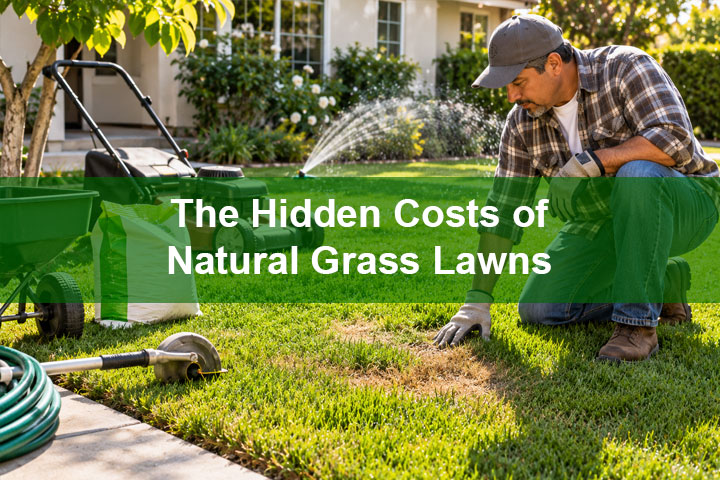
The true cost of a natural grass lawn goes far beyond the price of sod or grass seed. Water, mowing, fertilizer, equipment, irrigation repairs, weed control, and your own time can add up to a substantial recurring expense.
For many homeowners, the cost of natural grass is spread across so many bills and weekend chores that they never calculate the total.
However, natural grass also provides benefits artificial turf cannot fully replace, including evaporative cooling, living ground cover, and biological activity.
Our recommendation: Before replacing your lawn, calculate what you're actually spending each year. Compare that amount with the cost of improving your existing lawn, installing drought-tolerant landscaping, or switching to artificial grass.
Why Natural Grass Costs More Than Most Homeowners Realize
Ask a homeowner what their lawn costs, and they might mention a monthly landscaping bill or the price of fertilizer.
But those numbers rarely tell the full story.
Some expenses appear on your water bill. Others arrive as purchases at the garden center, replacement sprinkler heads, equipment repairs, or weekend trips to the hardware store.
Then there is the time spent mowing, edging, removing weeds, adjusting irrigation, and repairing worn areas.
A healthy lawn can be worth that effort. The important question is whether you're making the investment consciously or simply maintaining a landscape inherited from a previous homeowner.
The Seven Costs You Should Be Tracking
| Expense | What It Includes | Often Overlooked |
|---|---|---|
| Water | Seasonal lawn irrigation | Higher-tier water rates and inefficient sprinklers |
| Mowing | Landscaping service or DIY labor | Travel, cleanup, edging, and equipment upkeep |
| Fertilizer | Seasonal nutrients and application | Additional watering and repeat treatments |
| Weed and Pest Control | Products or professional treatments | Repeat visits and damaged lawn sections |
| Irrigation Repairs | Valves, heads, controllers, and pipes | Water wasted before leaks are discovered |
| Lawn Restoration | Seed, sod, soil amendments, and aeration | Recurring damage in problem areas |
| Your Time | Maintenance, shopping, troubleshooting | The value of lost leisure time |
1. Water: The Expense That Changes with Your Location
Water is one of the largest potential variables in the cost of natural grass, particularly in hot and dry regions.
According to the EPA WaterSense program, outdoor water use accounts for approximately 30% of household water consumption nationally, with substantially higher proportions possible in arid regions.
However, that percentage includes more than lawns, and no single national average can predict your home's irrigation costs.
Grass variety, climate, soil, shade, rainfall, and irrigation efficiency all matter.
How Much Water Does Your Lawn Need?
A useful starting point is understanding how much water covers a given area.
Applying one inch of water to 1,000 square feet requires approximately 623 gallons before accounting for irrigation losses.
For illustration, a 1,000-square-foot lawn receiving one inch of irrigation per week over 26 weeks would receive approximately 16,200 gallons.
That is not a universal annual watering recommendation. Actual requirements vary, rainfall can offset irrigation, and inefficient sprinklers may require considerably more water to deliver the intended amount.
To estimate your expense, multiply the water used by your utility's applicable marginal water rate. Some water providers measure consumption in hundred cubic feet rather than gallons.
For location-specific guidance, the University of California's lawn watering guide explains how grass type, soil, season, and irrigation performance influence water needs.
Buy-Grass Pro Tip
Don't calculate lawn water costs using your entire household water bill. Compare winter and summer consumption, adjust for other seasonal uses, and use your actual utility rate structure. The resulting estimate will be much more useful than a generic savings claim.
2. Mowing: Paying Someone or Paying with Your Time
Mowing is easy to overlook because homeowners typically think about it as a weekly chore rather than a financial commitment.
If you hire a landscaping company, the expense is straightforward: count the visits and the amount you pay for the lawn-related services.
If you maintain the lawn yourself, the cost is less obvious.
Consider the time required to:
- Mow the grass
- Edge sidewalks and planting beds
- Trim around trees and structures
- Collect or manage clippings
- Clean and maintain equipment
- Purchase fuel or charge batteries
For a homeowner who spends 45 minutes maintaining a lawn each week for 35 weeks, that represents more than 26 hours annually.
Whether you assign a dollar value to those hours is a personal decision. But the time commitment is real.
3. Fertilizer, Weed Control, and Lawn Treatments
Natural lawns are living plants. Maintaining an attractive appearance may require nutrients, weed management, and occasional treatment of pests or disease.
Some homeowners accomplish this with relatively little expense, especially when the grass species is well suited to the climate.
Others purchase multiple lawn-care products each year or hire a professional treatment service.
The hidden cost is not necessarily the price of one bag of fertilizer. It is the accumulated expense of maintaining the desired appearance over many seasons.
Overapplication can also create problems. Excess nutrients and pesticides may move with runoff into storm drains and waterways.
Healthy lawn management should be based on actual needs, not an automatic assumption that more treatment produces better grass.
4. Sprinkler Repairs and Irrigation Inefficiency
An irrigation system is a mechanical system, and mechanical systems require maintenance.
Sprinkler heads become damaged. Valves leak. Controllers need adjustment. Underground pipes may fail, and irrigation patterns change as landscaping grows.
Sometimes the problem is visible as water spraying onto the sidewalk. Other times, excess consumption goes unnoticed until the utility bill arrives.
The EPA reports that inefficient irrigation systems can waste substantial amounts of water through evaporation, wind drift, and runoff.
Before replacing a lawn because of high water bills, consider whether repairing or improving the irrigation system could produce meaningful savings.
Pressure-regulated sprinkler bodies, weather-based controllers, and better scheduling can sometimes reduce water consumption without removing natural grass.
5. Repeated Repairs to Bare Spots and Damaged Grass
Not every lawn remains healthy without intervention.
Heavy foot traffic, dogs, shade, compacted soil, drought, and uneven watering can produce recurring problem areas.
Homeowners may respond by buying more seed, replacing sod, adding topsoil, aerating, or installing additional irrigation.
These expenses are especially frustrating when the same problem returns year after year.
However, the correct solution is not always artificial grass.
A shaded side yard might benefit from mulch, stepping stones, or shade-tolerant plants. A heavily used dog run may benefit from artificial grass or another durable, drainable surface.
The goal should be solving the underlying problem rather than repeatedly replacing damaged grass.
6. Equipment Ownership and Replacement
DIY lawn maintenance often involves more equipment than a mower.
Depending on the property, homeowners may own a string trimmer, edger, blower, spreader, rake, hoses, sprinklers, and related supplies.
Equipment costs include the initial purchase, replacement batteries or fuel, repairs, blades, storage, and eventual replacement.
To estimate the annual cost, spread the purchase price over the equipment's expected useful life and add the recurring operating costs.
For example, a mower purchased for $400 and used for eight years represents an illustrative $50 annual purchase cost before repairs, energy, and other expenses.
This is not a prediction of equipment lifespan. It simply demonstrates how to account for large purchases over time.
7. The Cost of Maintaining a Lawn You Rarely Use
This may be the most important expense to reconsider.
Some homeowners maintain large front lawns primarily because the grass was already there when they purchased the property.
They pay for water, mowing, repairs, and seasonal care even though nobody uses the space for recreation.
That doesn't mean a traditional front lawn is a bad choice. Natural grass can provide cooling, visual appeal, and an attractive transition between the home and surrounding landscape.
But if the lawn serves little practical purpose, alternative landscaping deserves consideration.
A smaller lawn combined with drought-tolerant plants, trees, pathways, or selected areas of synthetic turf may better match how the property is used.
What Does a Natural Grass Lawn Cost Over Five Years?
Rather than relying on generic national cost averages, build a simple five-year estimate using your own expenses.
The following example is hypothetical. It is designed to demonstrate the calculation, not represent typical prices in any particular city.
| Expense | Illustrative Annual Cost | Five-Year Cost |
|---|---|---|
| Lawn irrigation | $350 | $1,750 |
| Mowing and edging | $600 | $3,000 |
| Fertilizer and treatments | $125 | $625 |
| Irrigation repairs | $75 | $375 |
| Lawn restoration | $100 | $500 |
| Total | $1,250 | $6,250 |
In this illustration, the five-year expense is $6,250, before inflation or the value of the homeowner's unpaid labor. Your actual cost could be much higher or lower.
For a meaningful comparison with artificial grass, include the synthetic turf installation cost, ongoing cleaning, occasional repairs, potential infill maintenance, and eventual replacement.
Also remember that artificial grass may require periodic rinsing and does not eliminate every landscaping expense.
Natural Grass vs. Artificial Grass vs. Drought-Tolerant Landscaping
There are three broad approaches worth comparing before making a major landscaping investment.
| Consideration | Natural Grass | Artificial Grass | Water-Wise Planting |
|---|---|---|---|
| Routine irrigation | Usually required | No growth irrigation | Varies; often reduced after establishment |
| Mowing | Regular | None | Usually none |
| Summer surface cooling | Benefits from evapotranspiration | Can become very hot | Benefits vary with plants and shade |
| Appearance | Seasonal and maintenance-dependent | Generally consistent | Seasonal, often diverse |
| Maintenance | Mowing, irrigation, and plant care | Cleaning, grooming, and inspection | Weeding, pruning, and occasional irrigation |
| Living habitat | Living plant cover and soil ecosystem | No living grass habitat | Can support habitat when well designed |
Buy-Grass assessment: Natural grass remains valuable where cooling, recreation, and living ground cover matter. Artificial grass may make sense for difficult, high-use areas. Water-wise planting can be a better solution for spaces that don't need a conventional lawn.
When Natural Grass Is Still Worth the Money
We wouldn't recommend removing a healthy, functional natural lawn simply because artificial grass requires less mowing.
Natural grass may be the better choice when:
- The lawn is actively used for recreation
- The climate supports the selected grass with modest irrigation
- Summer surface cooling is a priority
- The homeowner enjoys lawn care
- There is an established, efficient irrigation system
- Replacing the lawn would create unnecessary expense or waste
Natural lawns can also contribute to stormwater infiltration where soils and landscaping allow it.
The financial analysis should be part of the decision—not the entire decision.
Buy-Grass Pro Tip
Before converting an entire lawn, identify the sections that repeatedly cost you money. A muddy dog run, shaded side yard, or constantly damaged pathway might be a better candidate for artificial grass than a healthy main lawn.
Things We Wish Every Homeowner Knew
1. Water savings are local, not universal.
The same lawn can have dramatically different irrigation costs in coastal California, inland Southern California, and the desert Southwest.
2. Natural grass can be maintained more efficiently.
Improved irrigation, better grass selection, and appropriate watering schedules can reduce expenses without replacing the lawn.
3. Artificial grass isn't free to maintain.
It needs cleaning, debris removal, occasional brushing, and eventual replacement.
4. Your time has value.
Even if you enjoy mowing, it is worth understanding how many hours you spend maintaining the property.
5. The cheapest long-term landscape may be a combination.
Natural grass, synthetic turf, trees, planting beds, and hardscape can each serve different purposes.
Common Cost-Comparison Mistakes
Using the Entire Water Bill
Only the water attributable to lawn irrigation should be included in a lawn-cost comparison.
Ignoring Artificial Grass Installation Costs
Synthetic turf can require substantial upfront spending on excavation, base preparation, drainage, materials, and labor.
Comparing Only One Year
Initial installation costs and recurring expenses should be compared over a reasonable ownership period.
Forgetting Replacement
Artificial grass does not last forever. Include eventual replacement and disposal in long-term estimates.
Assuming Every Lawn Needs the Same Care
Grass variety, soil, climate, and maintenance expectations determine how much care is necessary.
Before You Buy: Calculate Your Actual Lawn Costs
Gather the following information before deciding whether to replace your lawn:
- Measure the lawn's square footage.
- Review 12 months of water usage and rates.
- Estimate irrigation attributable to the lawn.
- Add annual mowing or landscaping costs.
- Add fertilizer, weed control, and other treatments.
- Average irrigation repairs and lawn restoration expenses.
- Account for equipment replacement and operating costs.
- Estimate annual maintenance hours.
- Compare at least two realistic landscape alternatives.
- Include installation, upkeep, and eventual replacement in each option.
Our Recommendation
If we were evaluating the cost of natural grass at our own home, we would begin with actual expenses rather than assumptions about how much water or maintenance a typical lawn requires.
We would first determine whether the existing lawn could be maintained more efficiently.
Next, we would identify areas where natural grass performs poorly or serves little practical purpose.
For active recreation areas with manageable irrigation needs, we might keep natural grass. For muddy dog runs, narrow side yards, or locations with repeated lawn failure, artificial grass could be worth evaluating.
For ornamental areas, we would also consider climate-appropriate planting and shade trees.
The smartest landscaping decision isn't necessarily replacing every blade of natural grass. It's choosing the combination of surfaces and plants that delivers the most value for the way you actually live.
Continue Learning
- Artificial Grass Face Weight Explained
- Pile Height vs. Performance
- Artificial Grass Blade Shapes
- Explore More Artificial Grass Buying Guides
Is Your Natural Lawn Worth the Cost?
Before replacing your lawn, compare the true costs of irrigation, maintenance, repairs, and installation alternatives.
At Buy-Grass.com, we help homeowners understand artificial grass specifications, ownership expenses, and the tradeoffs between different landscaping options.
Spend your landscaping budget where it makes the biggest difference.