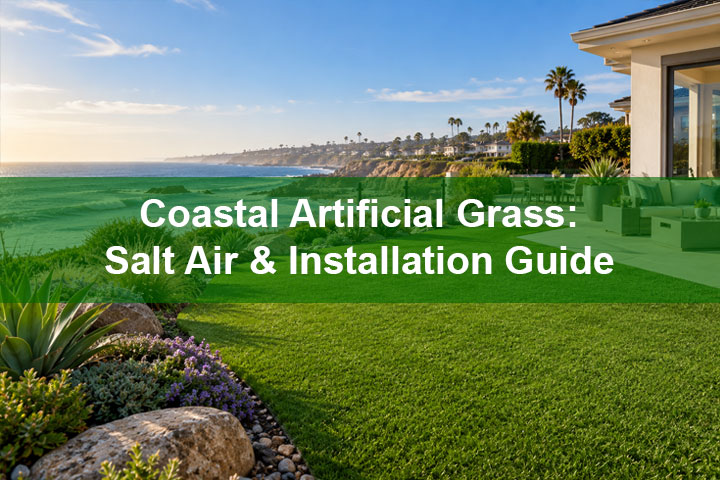
Coastal Installations: How Salt Air Affects Synthetic Turf
The 60-Second Answer
Coastal artificial grass can perform very well near the ocean, but the installation details matter more than many homeowners realize.
Salt air generally presents less of a problem for polyethylene and polypropylene turf fibers than for exposed metal hardware. However, coastal environments introduce additional challenges: blowing sand, salt deposits, moisture, strong winds, and accelerated corrosion of certain installation components.
Our recommendation is to prioritize UV-stabilized fibers, appropriate drainage, secure edging, corrosion-resistant hardware where required, and a maintenance plan suited to your property's exposure.
The takeaway: Don't shop for artificial grass based solely on whether the manufacturer calls it “coastal friendly.” Ask how the entire installation will perform near the ocean.
Who Should Consider Coastal Artificial Grass?
Artificial grass can be particularly useful for homeowners who want a consistently green outdoor space without maintaining a traditional lawn in challenging coastal conditions.
It may be a good fit for:
- Beachfront and ocean-view properties
- Vacation homes with limited maintenance schedules
- Coastal rental properties
- Small patios and courtyards
- Residential lawns exposed to salt spray
- Poolside and outdoor entertainment areas
However, artificial grass isn't automatically the best choice for every coastal property.
Homes located directly on exposed beachfronts, where sand constantly accumulates or storm-driven water regularly crosses the property, require additional evaluation.
Does Salt Air Actually Damage Artificial Grass?
This is where the conversation gets interesting.
Most residential artificial grass fibers are manufactured from polyethylene, polypropylene, or related synthetic materials. These polymers do not rust the way steel does, and ordinary airborne salt exposure is not generally their primary durability concern.
However, that does not mean coastal conditions are irrelevant.
Salt can accumulate on the turf surface. Wind can carry abrasive sand into the fibers. Coastal moisture can influence drainage conditions, while salt-laden air can accelerate corrosion of susceptible metal components.
Sunlight and mechanical wear also remain important factors in turf aging.
What About Salt Deposits?
Ocean spray can leave a light salt residue on exposed surfaces, including artificial grass.
Occasional freshwater rinsing can help remove these deposits, especially on properties close enough to the shoreline to receive regular sea spray.
Homeowners farther inland may find that ordinary rainfall and periodic cleaning are sufficient.
What About UV Exposure?
Coastal sunshine can be intense, particularly in Southern California.
UV stabilization helps protect synthetic fibers against sunlight-related degradation. When comparing products, request information about UV testing and warranty coverage rather than relying on broad marketing claims.
The Biggest Coastal Installation Risks
We would pay attention to five areas before choosing turf for an oceanfront or near-ocean property.
| Coastal Challenge | Potential Problem | Recommended Response |
|---|---|---|
| Salt deposits | Surface residue | Periodic freshwater rinsing |
| Windblown sand | Accumulation between fibers | Regular debris removal and thoughtful landscape barriers |
| Coastal moisture | Slow drainage or trapped water | Evaluate base materials, grading, and drainage |
| Salt-related corrosion | Deterioration of susceptible hardware | Specify suitable corrosion-resistant components |
| Strong winds | Edge movement or installation stress | Secure perimeter construction and appropriate anchoring |
Buy-Grass Pro Tip
For a beachfront property, we'd spend more time discussing drainage, edging, and fastening materials with the installer than debating whether the grass should be 1.5 or 1.75 inches tall. Those installation details may have a greater effect on long-term performance.
Why Windblown Sand Deserves Special Attention
Salt air gets most of the attention, but blowing sand can create a more immediate maintenance problem.
Sand can settle between artificial grass fibers, particularly in areas close to beaches, dunes, or exposed coastal pathways.
Small amounts may be manageable. Repeated heavy accumulation can make cleaning more difficult and change the feel of the surface.
Before installation, consider where the sand is coming from.
If the property receives regular sand deposits, the solution may involve more than choosing a different turf product.
Practical Design Solutions
- Install appropriate landscape borders to reduce sand movement.
- Use pathways near beach access points.
- Consider wind-tolerant planting beds where appropriate.
- Provide easy access for cleaning equipment.
- Avoid creating corners where sand accumulates and becomes difficult to remove.
For heavily exposed beachfront properties, a combination of hardscape and limited turf areas may be more practical than covering the entire yard with synthetic grass.
Choosing the Right Turf for Coastal Conditions
The best coastal artificial grass is not necessarily the thickest, softest, or most expensive product.
We would compare the following characteristics.
Fiber Quality
Look for products with documented UV stabilization and suitable outdoor durability.
Pile Height
Medium pile heights can provide a useful balance between appearance and cleaning convenience.
Very tall, dense turf may be attractive but can make removing accumulated sand and debris more labor-intensive.
See our Pile Height vs Performance Guide.
Backing Construction
Backing affects tuft retention, dimensional stability, and drainage design.
Both polyurethane and latex-backed systems are available, and performance depends on the complete product construction.
Our Polyurethane vs Latex Backing Guide explains the differences.
Drainage
Ask for the manufacturer's drainage specifications and discuss how the proposed base will handle local soil conditions and rainfall.
A permeable turf product will not solve a drainage problem if the underlying soil or installation base cannot accept water.
Coastal Turf Selection: Our Decision Guide
| Property Type | Our Priority | Why |
|---|---|---|
| Oceanfront home | Secure installation and corrosion resistance | Greater exposure to wind and salt spray |
| Coastal vacation rental | Durability and easy cleaning | Frequent guests and limited maintenance windows |
| Coastal family backyard | Comfort and drainage | Daily recreation and outdoor living |
| Beach-adjacent courtyard | Easy debris removal | Sand and leaves can accumulate in enclosed areas |
| Protected coastal property | Overall turf quality and appearance | Less direct exposure to ocean conditions |
Things We Wish Every Coastal Homeowner Knew
1. Salt air and saltwater flooding are different problems.
Ordinary ocean air is not equivalent to having storm surge or seawater regularly wash across your lawn. Properties exposed to flooding require separate drainage, contamination, and site-design considerations.
2. The installation hardware deserves attention.
Some metal fasteners and accessories can corrode in marine environments. Ask the installer which components are suitable for the property's exposure and whether alternative anchoring methods are appropriate.
3. A drainage rate on a product label is not a guarantee.
Water must move through the entire installation system. Backing permeability is only one part of that process.
4. More expensive turf does not automatically mean easier maintenance.
A luxurious, ultra-dense product may trap more debris than a simpler turf designed for easy cleaning.
5. Coastal landscaping should be designed as a complete environment.
Wind exposure, plants, hardscape, irrigation, drainage, and maintenance access all influence the finished result.
What About Coastal Landscaping and Water Conservation?
Artificial grass can reduce the irrigation needed for a conventional lawn, but that does not mean every coastal property should replace all natural vegetation with synthetic turf.
Native and regionally appropriate plants can provide habitat, shade, and other environmental benefits that artificial grass cannot replace.
The EPA WaterSense landscaping guidance recommends selecting plants suited to local conditions and designing landscapes around actual site requirements.
For many coastal homes, our preferred approach would combine a functional artificial grass area with appropriate coastal planting and hardscape.
This can provide usable green space without turning the entire property into a synthetic lawn.
Common Mistakes in Coastal Artificial Grass Installations
Ignoring Wind Exposure
An installation protected by surrounding buildings faces different conditions from one exposed directly to strong ocean winds.
Perimeter security, edging, and anchoring should reflect those differences.
Using Unsuitable Hardware
Coastal corrosion can affect exposed metal components. Hardware specifications should be appropriate for the location.
Choosing Turf Based Only on Appearance
A beautiful sample does not reveal how easily the product will release accumulated sand or how the backing performs.
Overlooking Drainage
Coastal soils vary considerably. Sandy soil may drain rapidly, while compacted or poorly graded sites can retain water.
Do not assume proximity to the beach guarantees excellent drainage.
Expecting Zero Maintenance
Artificial grass eliminates mowing and routine lawn irrigation, but salt deposits, sand, leaves, and other debris still need attention.
Before You Buy: Ask These Five Questions
Before purchasing coastal artificial grass, ask your supplier or installer:
- What UV testing and warranty documentation is available for this turf?
- How will the installation handle wind exposure and perimeter anchoring?
- Which fasteners and accessories are suitable for coastal conditions?
- How will sand and salt deposits be removed during routine maintenance?
- How will the complete installation drain during heavy rainfall?
If the installer cannot answer these questions clearly, consider getting another proposal before committing.
Our Recommendation
For a coastal home, we would choose artificial grass based on the property's actual exposure rather than its distance from the ocean alone.
A protected backyard several blocks inland may require little more than a quality residential turf system and standard maintenance.
A directly exposed oceanfront property deserves a more detailed installation plan, with particular attention to wind, corrosion, drainage, and sand accumulation.
We would not automatically pay more for the tallest pile height or the highest face weight.
Instead, we would prioritize proven product construction, cleanability, appropriate installation materials, and an installer who understands coastal conditions.
And if the property receives frequent sand deposits or storm-driven seawater, we would seriously consider whether a smaller turf area combined with hardscape and coastal planting would be the better long-term solution.
Continue Learning
- Artificial Grass Blade Shapes Explained
- Pile Height vs Performance
- Artificial Grass Face Weight Explained
- Polyurethane vs Latex Backing
Frequently Asked Questions
Can salt air damage artificial grass?
Ordinary salt air is not generally the primary threat to synthetic turf fibers. However, salt deposits, windblown sand, moisture, UV exposure, and corrosion of installation hardware can affect the overall installation.
Does artificial grass need special maintenance near the ocean?
Coastal properties may require more frequent debris removal and occasional freshwater rinsing, depending on their exposure to salt spray and blowing sand.
Is artificial grass suitable for beachfront homes?
It can be, provided the installation accounts for wind, drainage, sand, corrosion, and local site conditions. Properties exposed to storm surge require additional evaluation.
What is the best pile height for coastal artificial grass?
For many residential applications, a medium pile height provides a practical balance of appearance, comfort, and cleaning convenience. The best choice depends on traffic, sand exposure, and intended use.