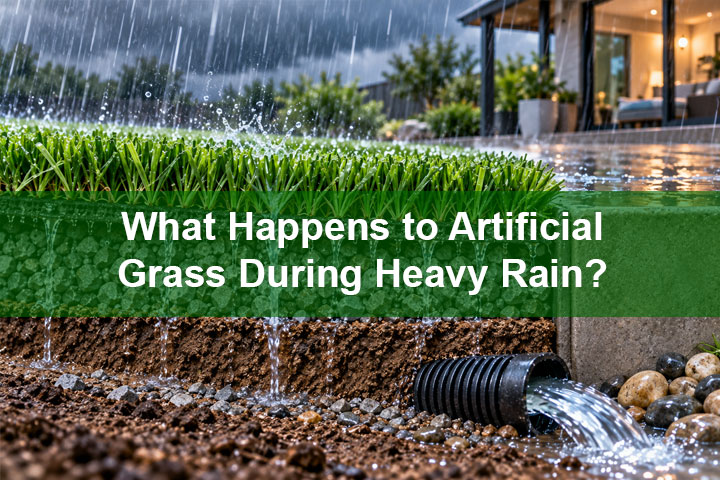
Artificial grass in heavy rain should generally do something fairly unremarkable: get wet, allow water to move through or across the surface, and begin drying once the storm passes.
A properly designed artificial-grass system can handle substantial rainfall without turning into mud or remaining waterlogged like a poorly draining natural lawn.
But there is an important catch.
The artificial grass itself is only the top layer of the drainage system.
Water still has to pass through the turf backing, move through the base, reach the soil or drainage system below, and ultimately travel somewhere away from the yard.
If any part of that path fails, heavy rain tends to expose it very quickly.
Heavy rain usually doesn’t damage a good artificial lawn. It tests whether everything underneath it was designed correctly.
What Happens When Rain Hits Artificial Grass?
During rainfall, water first lands on the synthetic fibers.
From there, it generally moves in two directions:
- Down through the turf backing
- Across the surface following the grade of the yard
How much water moves each way depends on the turf, backing design, infill, slope, installation, and intensity of the storm.
Most landscape turf uses either a perforated backing with drainage holes or a more fully permeable backing designed to let water pass through a larger portion of the carpet. Turf manufacturers use both approaches. citeturn819072search0turn819072search3
Once the water gets through the backing, however, the turf has essentially done its part.
Now the rest of the yard has to handle the water.
The 4 Layers of Artificial-Grass Drainage
When homeowners hear that artificial grass “drains,” they often picture water disappearing through tiny holes in the turf.
That’s only step one.
| Layer | What It Does | What Can Go Wrong |
|---|---|---|
| Turf backing | Allows water through the artificial grass | Blocked or insufficient drainage openings |
| Base | Allows water to move beneath the turf | Poor materials, settling or inadequate preparation |
| Native soil | Absorbs or transfers water | Clay or poorly draining soil becomes saturated |
| Site drainage | Moves excess water away | Poor grading, low spots or nowhere for runoff to go |
A failure at any of these layers can create standing water.
Drainage Holes Don’t Guarantee a Dry Lawn
This may be the single most important thing homeowners should understand about artificial-grass drainage.
A turf manufacturer might advertise an impressive drainage rate.
That number describes how quickly water can pass through the turf product under specific conditions.
It does not necessarily describe how quickly water can leave your property.
Imagine pouring water through a kitchen colander.
The holes work beautifully.
Now put that colander inside a bowl.
The water still passes through the holes—but it has nowhere to go afterward.
Your artificial lawn can experience essentially the same problem.
Buy-Grass Take: When comparing turf products, we would care less about an enormous advertised drainage number than about whether the installer can explain the complete path water will take through your yard.
What Happens to the Base During Heavy Rain?
Beneath most properly installed landscape turf is a compacted aggregate base.
This layer performs several jobs:
- Creates a stable surface
- Helps maintain the grade
- Supports the turf
- Allows water to move through the installation
Manufacturers and installers commonly recommend permeable crushed-stone or aggregate materials because they provide both structural support and drainage. citeturn819072search0turn819072search10
During heavy rain, water enters the base and moves through the voids between aggregate particles.
If the base is properly constructed, this happens without much drama.
If it isn’t, heavy rainfall may reveal:
- Soft spots
- Depressions
- Slow-draining areas
- Settlement
- Uneven turf
Sub-base problems can eventually cause the turf above to dip or settle as well. citeturn819072search24
What If You Have Clay Soil?
This is where an otherwise good turf installation can run into trouble.
Clay soil can absorb water slowly.
During prolonged or intense rainfall, the native ground beneath the turf system can become saturated.
The turf backing might be draining perfectly.
The aggregate base might also be working correctly.
But if the soil underneath cannot accept additional water quickly enough, drainage can slow throughout the system.
That is why sites with poor native drainage may need additional measures such as:
- A deeper drainage base
- French drains
- Drainage pipe
- Catch basins
- Drainage mats
- Regrading
The appropriate solution depends on the property.
Can Artificial Grass Flood?
Yes.
Artificial grass is permeable flooring—not a stormwater disposal system.
If rain falls faster than the entire property can move or absorb it, water can temporarily accumulate on top of the turf.
This may occur during:
- Very intense storms
- Flash flooding
- Blocked drains
- Overflow from neighboring properties
- Saturated soils
- Poorly graded yards
A brief period of standing water during an unusually intense storm is different from a lawn that remains puddled long afterward.
The second situation deserves investigation.
Should Artificial Grass Have Puddles After Rain?
Ideally, significant standing water should disappear relatively quickly after rainfall ends.
Even commercial synthetic-field guidance treats persistent ponding or unusually slow drainage as something worth investigating because it may indicate a sub-base or drainage issue. citeturn819072search1turn819072search24
If one part of your artificial lawn consistently remains underwater while the rest drains normally, that tells you something useful.
The problem may be local rather than turf-wide.
Possible Causes of One Persistent Puddle
- A low spot in the base
- Settlement beneath the turf
- Poor grading
- A clogged drain
- Compacted material
- Blocked turf perforations
- Clay or saturated soil underneath
The puddle is a symptom.
The goal is to find the cause.
Can Heavy Rain Wash Away Artificial Grass?
A properly secured installation generally should not move simply because it rains.
But water is powerful.
If a property experiences uncontrolled runoff, flooding, erosion, or fast-moving water, damage can occur around or beneath the turf.
This is especially important on:
- Sloped yards
- Hillsides
- Properties below neighboring lots
- Areas near drainage channels
- Sites with existing erosion
In those situations, the concern isn’t ordinary rainfall landing on the turf.
The concern is moving water carrying soil and base material with it.
Once the foundation underneath artificial grass begins to move, the turf above can wrinkle, sink or become uneven.
Can Infill Wash Away?
Some infill movement is possible during very heavy rain, particularly if water travels rapidly across the turf surface.
How much depends on:
- Slope
- Type of infill
- Amount of infill
- Fiber density
- Surface runoff
- Edge design
On a properly installed relatively flat residential lawn, widespread infill loss from ordinary rainfall should not be expected.
But steep slopes and concentrated runoff deserve more attention.
This connects directly to another specification homeowners rarely think about: some turf fibers and turf systems are designed specifically to improve infill retention.
What Happens at the Edges of the Lawn?
Edges can become particularly important during heavy rain.
Runoff naturally looks for the easiest path downhill.
If water repeatedly reaches an unsecured turf edge, it can potentially:
- Wash out surrounding soil
- Move loose aggregate
- Expose the turf backing
- Create voids
- Undermine edging
This is one reason proper perimeter restraint matters.
Edging isn’t merely there to make the installation look neat.
It also helps maintain the structure of the system.
What About Artificial Grass Installed on Concrete?
Artificial grass installed over concrete behaves differently because water cannot simply soak into the ground below.
The existing slab therefore needs adequate slope and drainage.
If water already pools on the concrete before turf is installed, covering it with artificial grass does not solve the underlying drainage problem.
Water may instead become trapped between the turf and slab.
Manufacturers recommend correcting poor drainage or using an appropriate drainage layer when installing turf over surfaces that cannot absorb water. citeturn819072search8
Can Heavy Rain Cause Mold Under Artificial Grass?
Artificial grass itself does not automatically develop mold simply because it gets wet.
Outdoor turf is designed to experience rain.
The concern arises when moisture becomes chronically trapped.
Persistent dampness combined with organic debris can create conditions where biological growth or odor becomes more likely.
That is why repeated standing water should not simply be accepted as normal.
A lawn that gets soaked and drains is doing its job.
A lawn that stays wet because water is trapped beneath it deserves attention.
Does Artificial Grass Become Slippery in the Rain?
Like almost any outdoor surface, artificial grass will feel different when wet.
But properly installed landscape turf should normally remain usable during and after ordinary rain.
The bigger safety issues generally come from:
- Standing water
- Steep slopes
- Mud or debris carried onto the turf
- Algae or organic buildup in chronically damp areas
Again, drainage and maintenance matter more than simply whether the fibers are wet.
Heavy Rain Is Actually a Useful Inspection
This may sound strange, but the first major storm after an artificial-grass installation can teach you a lot.
When it rains heavily, look at the yard.
Don’t just look at the turf.
Look at the water.
Watch For:
- Where water enters the yard
- Where runoff travels
- Whether water crosses the turf or drains through it
- Whether particular areas puddle
- Whether drains keep up
- Where water leaves the property
- Whether surrounding soil is eroding
You are essentially watching the drainage system operate in real time.
Artificial Grass vs. Natural Grass During Heavy Rain
| Heavy Rain Issue | Natural Grass | Artificial Grass |
|---|---|---|
| Mud | Common when saturated | Generally no mud at surface |
| Puddling | Possible | Possible if drainage is inadequate |
| Soil compaction | Can reduce drainage | Base design is more important |
| Surface damage | Wet soil can rut or tear | Usually remains stable if base is sound |
| Usability after rain | May require drying time | Often usable sooner |
| Erosion | Possible | Possible beneath or around turf if runoff is uncontrolled |
Things We Wish Every Homeowner Knew
1. Drainage rate is not the same as yard drainage
A turf backing might move water extremely quickly while the soil underneath drains slowly.
2. Water still needs somewhere to go
Artificial grass cannot make rainfall disappear.
3. Existing drainage problems should be fixed before installation
Covering a low spot or poorly draining yard does not eliminate the underlying problem.
4. Heavy rain is a good test of installation quality
Puddles, erosion or settlement can reveal issues that were invisible when the yard was dry.
5. The base matters as much as the turf
A premium artificial grass product over a poorly designed drainage system can still perform badly.
7 Drainage Questions to Ask Before Installing Artificial Grass
- Where does rainwater currently go on my property?
- What kind of soil is underneath the proposed installation?
- What material will be used for the base?
- How will the yard be graded?
- Where will water go after it passes through the turf?
- Do we need drains, catch basins or other drainage improvements?
- What happens during an unusually heavy storm?
That final question is particularly revealing.
You don’t just want to know how your lawn will handle a garden hose.
You want to know what the entire yard will do when several inches of rain try to move through it.
So, What Happens to Artificial Grass During Heavy Rain?
Usually, it gets wet and drains.
Water passes through the turf backing, enters the base and continues into the underlying soil or drainage system.
A well-designed artificial lawn may actually remain cleaner and become usable sooner than a natural lawn because there is no muddy surface soil to contend with.
But heavy rain also exposes weaknesses.
Low spots become puddles. Poor soil becomes saturated. Bad grading sends water in the wrong direction. Weak base construction may settle. Inadequate drainage can leave water trapped underneath the turf.
That gives us a simple rule:
Don’t judge artificial-grass drainage by how quickly water passes through the carpet. Judge it by how successfully water leaves the entire property.
The turf is only one part of that journey.