If you have ever compared artificial grass specifications, you may have encountered terms such as monofilament and fibrillated without much explanation of why they matter.
At first glance, both are simply plastic fibers designed to look or perform like grass.
But they are made differently, and that difference affects how the finished turf behaves.
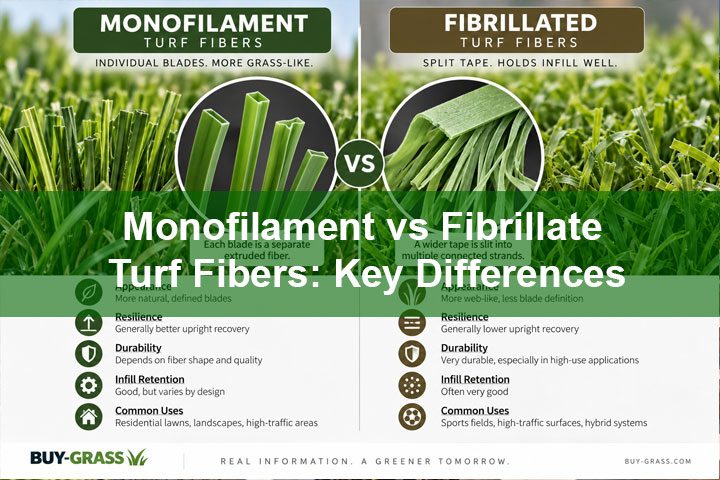
In a monofilament vs fibrillated turf comparison, monofilament fibers generally offer better blade definition, resilience and a more grass-like appearance, while fibrillated fibers are especially useful for holding infill in place and creating a dense, interconnected surface structure.
Neither construction is automatically “better.”
The important question is:
What job is the fiber being asked to do?
What Is a Monofilament Turf Fiber?
A monofilament fiber is manufactured as an individual strand.
Think of each blade as its own separate piece of yarn.
During manufacturing, molten polymer is extruded through a die that determines the blade’s profile. Manufacturers can change characteristics such as:
- Blade width
- Thickness
- Shape
- Color
- Surface texture
- Polymer formulation
This is why artificial grass manufacturers offer so many blade shapes, including:
- C-shaped fibers
- V-shaped fibers
- W-shaped fibers
- Diamond-shaped fibers
- Flat blades
- Blades with a reinforcing spine
Each blade remains a distinct fiber rather than being connected to neighboring blades.
What Is a Fibrillated Turf Fiber?
Fibrillated yarn begins differently.
Instead of producing separate grass blades from the start, manufacturers first create a wider, tape-like strip of synthetic material.
That tape is then slit or partially split into smaller connected strands.
The result resembles a small net or web when the fiber opens up.
This structure allows fibrillated fibers to spread through the turf and interact with the infill.
That is one reason fibrillated yarn has historically been useful in sports surfaces: it can help keep sand or performance infill distributed through the turf rather than allowing it to move as freely. citeturn173149search0turn173149search4
The Easiest Way to Picture the Difference
Imagine two ways of making fringe.
Monofilament: Cut 20 individual strings and attach them separately.
Fibrillated: Start with one ribbon and cut multiple slits into it while leaving portions connected.
Both create strands.
But structurally, they are very different.
Monofilament vs Fibrillated Turf at a Glance
| Characteristic | Monofilament | Fibrillated |
|---|---|---|
| Fiber construction | Individual blades | Slit or split tape |
| Appearance | Generally more grass-like | More web-like as fibers open |
| Blade definition | High | Lower |
| Upright resilience | Generally better | Generally lower |
| Infill retention | Depends on turf design | Often very good |
| Typical residential use | Very common | Less common as the primary visible yarn |
| Sports use | Very common | Still useful for certain sports and hybrid systems |
Why Monofilament Turf Usually Looks More Like Natural Grass
For residential landscaping, appearance is one of the biggest reasons monofilament fibers have become so common.
Natural grass consists of individual blades.
Monofilament turf copies that basic visual structure.
Manufacturers can combine:
- Different blade shapes
- Multiple shades of green
- Different fiber thicknesses
- Brown or tan thatch fibers beneath the surface
to create a much less uniform appearance.
That variation helps modern artificial grass avoid the older “green carpet” look associated with earlier synthetic surfaces.
Why Fibrillated Fibers Are Good at Holding Infill
This is where fibrillated yarn becomes particularly interesting.
As the slit tape opens, the connected strands can form a web-like structure around the infill.
That can help reduce infill movement and splash in applications where maintaining a consistent playing surface matters.
Manufacturers still use fibrillated yarn for this reason, either on its own or in combination with monofilament fibers. Some modern sports systems intentionally combine both constructions so monofilaments provide resilience while fibrillated fibers help stabilize infill. citeturn173149search3turn173149search7
Which Fiber Stands Up Better?
In general, monofilament fibers have the advantage when upright resilience matters.
Because each blade is manufactured independently, its shape can be engineered to improve stiffness and recovery after being stepped on.
A V-shaped or ribbed monofilament blade, for example, may have much more structural memory than a flat strip of plastic.
Fibrillated yarn can be extremely durable, but durability and standing upright are not exactly the same thing.
A fiber can remain physically intact while still flattening.
That distinction matters.
Buy-Grass Take: When comparing turf samples, don’t ask only, “Will this fiber last?” Also ask, “What will it look like after thousands of footsteps?”
Durability Is More Complicated Than Fiber Type
It would be convenient if homeowners could simply conclude:
Monofilament = durable
Fibrillated = less durable
But artificial grass specifications rarely work that neatly.
Fiber durability also depends on:
- Polymer quality
- Fiber thickness
- Dtex
- Blade geometry
- UV stabilizers
- Tufting density
- Pile height
- Infill
- Backing quality
- Traffic level
A high-quality fibrillated system may easily outperform a poorly designed monofilament product.
Likewise, two monofilament products can behave very differently if one uses stronger yarn geometry or a heavier fiber.
Fiber construction is one specification—not the entire turf system.
What Happens to Fibrillated Fibers as They Wear?
Fibrillated turf gets part of its name from what happens to the yarn.
The original tape contains cuts that allow it to progressively open into narrower strands.
As the turf is used and brushed, those strands separate and spread.
This can make the surface appear denser.
But it can also make individual blades less distinct and contribute to a flatter appearance over time.
That isn’t necessarily a defect.
In applications where infill control and surface consistency matter more than the appearance of individual grass blades, that behavior may actually be useful.
Residential Lawns: Which Would We Choose?
For most front yards and backyards where homeowners want a realistic lawn appearance, we would generally favor a turf system using monofilament fibers as the primary visible blade.
The reasons are straightforward:
- Better blade definition
- More natural visual variation
- More blade-shape options
- Better upright recovery in many products
- More realistic lawn appearance
That does not mean every component of the turf needs to be monofilament.
Modern landscape turf often combines several yarn types.
Pet Turf: Fiber Type Is Only Part of the Decision
For dog owners, fiber construction matters—but perhaps less than some other specifications.
We would pay just as much attention to:
- Drainage rate
- Backing design
- Pile height
- Density
- Ease of rinsing
- Infill choice
- Odor-management strategy
A beautiful monofilament turf with poor drainage may be a worse pet surface than a less visually sophisticated system with excellent drainage.
This is a recurring Buy-Grass theme:
The most visible specification is not always the most important specification.
Sports Fields Are Where the Comparison Gets More Interesting
Sports turf is designed around performance rather than simply appearance.
That changes the priorities.
A football or soccer surface may need to manage:
- Infill migration
- Ball roll
- Player traction
- Impact absorption
- Fiber recovery
- Heavy repetitive traffic
That is why sports systems sometimes mix multiple fiber types.
For example, manufacturers offer turf combining resilient monofilament blades with fibrillated fibers specifically to balance upright performance with infill retention. citeturn173149search3turn173149search7
This is a good reminder that turf design is not always about choosing one “best” yarn.
Sometimes the best system uses multiple yarns to perform different jobs.
Hybrid Fiber Systems: The Best of Both?
Artificial grass manufacturers increasingly combine fibers rather than relying on a single yarn construction.
A turf might contain:
- Straight monofilament blades for appearance
- Curly fibers for support
- Fibrillated fibers for infill control
- Thatch fibers for density and realism
Each fiber can perform a different function.
This is similar to building a mattress with multiple layers rather than expecting one material to provide support, cushioning, cooling and durability simultaneously.
The real question becomes:
Why did the manufacturer combine these particular fibers?
Don’t Confuse Fibrillated Fibers with Thatch
This is an easy mistake for shoppers to make.
Thatch fibers are the shorter, often brown, tan, or green curly fibers near the bottom of many residential artificial lawns.
They are designed to:
- Add density
- Support taller blades
- Hide the backing
- Make the turf look more like a natural lawn
Fibrillated fibers are defined by how the yarn itself is manufactured from split tape.
They are not simply another name for thatch.
Can You Identify the Fiber Type by Looking at a Sample?
Sometimes.
With monofilament turf, you can usually separate individual blades and examine their shape.
Fibrillated fibers may look flatter and may reveal multiple connected strands when spread apart.
But modern turf systems can contain several fiber constructions in a single sample.
So the better approach is to ask for the manufacturer’s technical specification sheet.
What We’d Ask Instead of “Which Fiber Is Better?”
If you are comparing turf products, ask:
- What fiber types are used in this product?
- What job is each yarn performing?
- How well do the blades recover after traffic?
- How does the turf retain infill?
- How will it look after several years of use?
- Is this yarn construction appropriate for my application?
Those questions reveal much more than simply asking whether the turf is monofilament or fibrillated.
Monofilament vs Fibrillated Turf by Application
| Application | Our General Preference | Why |
|---|---|---|
| Decorative front lawn | Monofilament-dominant | Natural appearance and blade definition |
| Family backyard | Monofilament or mixed system | Balance of appearance and resilience |
| Dog yard | Application-specific turf | Drainage may matter more than yarn type |
| High-traffic commercial landscape | Resilient monofilament or hybrid | Recovery after repeated traffic |
| Sports field | Application-specific mono, fibrillated or hybrid system | Performance requirements vary by sport |
| Putting green | Specialized short-pile system | Ball performance matters more than lawn realism |
Things We Wish Every Homeowner Knew
1. “Monofilament” does not automatically mean premium
It’s a construction method, not a quality grade.
2. Fibrillated yarn is not obsolete
Its ability to help manage infill can still make it valuable in sports and hybrid turf systems.
3. Blade shape matters within monofilament turf
Two monofilament products can perform very differently depending on geometry, thickness and polymer formulation.
4. The best turf may use several fiber types
A mixed-yarn system can intentionally combine appearance, support and infill retention.
5. Buy the system, not the buzzword
A homeowner will live with the completed turf—not with the terminology on the specification sheet.
So, Which Is Better: Monofilament or Fibrillated Turf?
For most residential lawns, we would generally favor monofilament fibers for the primary visible grass blades because they can provide better blade definition, resilience and natural-looking variation.
For certain sports applications, heavy-use surfaces and systems where controlling infill is especially important, fibrillated fibers can offer useful advantages.
And increasingly, the answer isn’t one or the other.
Manufacturers can combine monofilament, fibrillated, curly and thatch fibers so each component performs a different job.
That leads to our bigger buying rule:
Don’t choose artificial grass because one specification sounds better. Find out why every part of the turf was designed the way it was.
Understanding the difference between monofilament and fibrillated fibers is useful—not because it gives you one more specification to obsess over, but because it helps you recognize what a turf manufacturer is trying to accomplish.
And once you understand that, product comparisons become much easier.