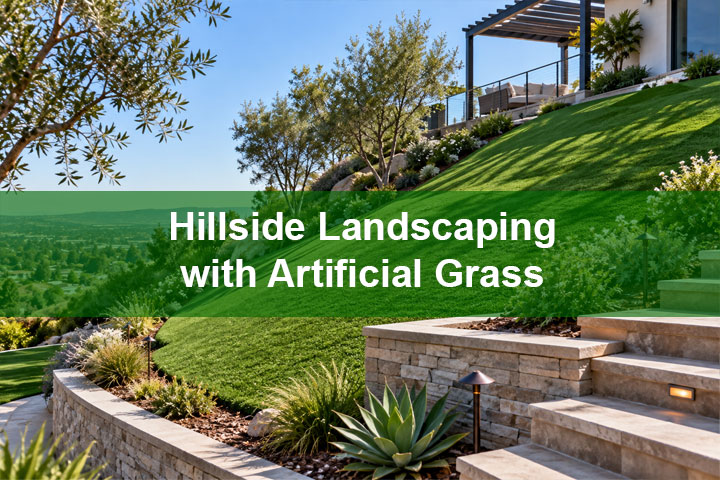
Artificial grass on a hillside can solve several problems at once. It can cover a difficult-to-mow slope, create a cleaner-looking landscape, reduce irrigation, and provide year-round green coverage where natural grass struggles.
But installing turf on a hill is not the same as rolling artificial grass across a flat backyard.
Gravity changes almost everything.
Water moves faster. Base material can migrate. Infill can shift. Seams experience different stresses. Edges need more support. And if the hillside itself is unstable, synthetic turf will not magically stabilize it.
That leads to the most important principle in this guide:
Artificial grass can cover a slope. It cannot fix a bad slope.
If the grade is stable and drainage is properly designed, synthetic turf can be an excellent hillside landscaping material. If the hill is eroding, slipping, retaining water, or directing runoff toward a structure, those problems should be solved before the turf goes down.
Why Artificial Grass Makes Sense on a Hillside
Sloped landscapes can be some of the hardest areas of a property to maintain.
Natural grass on a hillside may require:
- Difficult or unsafe mowing
- Regular irrigation
- String trimming
- Fertilization
- Weed control
- Erosion repair
- Reseeding or sod replacement
Natural lawns can also struggle where irrigation water runs downhill before soaking evenly into the soil.
Artificial grass eliminates mowing and removes the need to maintain living turfgrass on the slope.
That is particularly useful on slopes that are mostly visual landscaping rather than spaces where people regularly walk or play.
The First Question Isn’t Turf. It’s the Hill.
Before choosing a turf product, look at the hillside itself.
Ask:
- Is the soil stable?
- Is there visible erosion?
- Are there cracks or signs of soil movement?
- Where does rainwater travel?
- Does water collect at the bottom?
- Does runoff move toward the house?
- Are retaining walls already present?
- Are tree roots helping stabilize the slope?
A synthetic lawn is ultimately a finish surface installed over a prepared base.
If the soil beneath that base moves, the turf moves with it.
This is why we would be cautious about any contractor whose hillside evaluation begins with turf samples instead of the slope itself.
Not All Slopes Are the Same
Homeowners often use the words slope and hillside interchangeably, but the degree of the slope changes the project considerably.
| Type of Slope | What We Would Expect | Main Concern |
|---|---|---|
| Gentle grade | Similar to a conventional turf installation with careful drainage | Water direction and edge security |
| Moderate slope | More anchoring, stronger perimeter restraint and careful base preparation | Turf creep, base movement and runoff |
| Steep hillside | Possible terracing, retaining structures or engineered stabilization before turf | Erosion and slope stability |
There is no universal percentage at which artificial grass suddenly becomes impossible.
Soil conditions, retaining walls, drainage, access, climate, the intended use of the area, and local building requirements all matter.
That is why we would be skeptical of a blanket claim such as:
“Artificial grass can be installed on any slope.”
Technically possible and practically wise are not always the same thing.
Drainage Becomes More Important on a Hill
On flat ground, homeowners tend to worry about water pooling.
On a hillside, the opposite problem can be just as important:
Water may move too quickly.
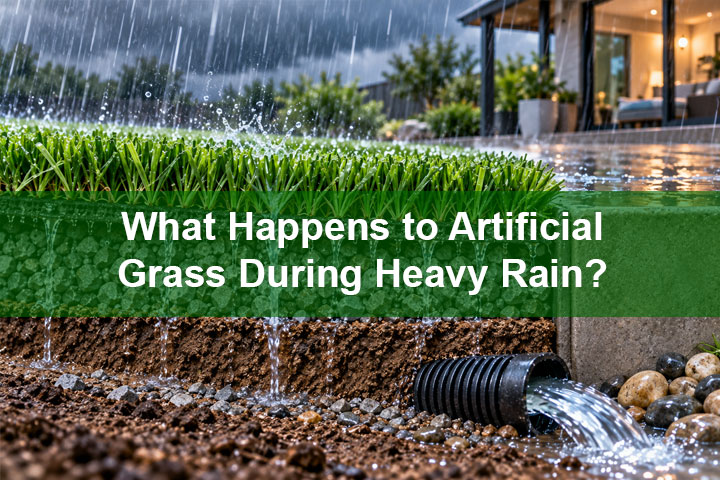
Rain falling on a steep slope can concentrate as runoff. That moving water can carry soil or fine base material downhill if the underlying system is not properly designed.
The turf backing may be highly permeable, but that only answers one part of the drainage question.
Water still needs somewhere to go once it passes through the turf.
The Question to Ask Your Installer
Where will water go during a heavy rain?
A useful answer should address the entire hillside—not just drainage holes in the turf.
Depending on the site, the plan might involve:
- Properly graded aggregate
- A drainage layer
- French drains
- Catch basins
- Swales
- Drainage at the bottom of the slope
- Retaining or terracing features
Particular attention should be paid to the toe of the slope—the area where runoff reaches the bottom of the hill.
If water repeatedly concentrates there, it can undermine the base or create erosion beyond the turf installation.
Can Artificial Grass Stop Hillside Erosion?
This requires an important distinction.
Artificial grass can help protect a properly prepared surface from direct rainfall and everyday surface disturbance.
But artificial turf should not be treated as a structural erosion-control system.
If the hillside is actively losing soil, developing channels during storms, or showing signs of movement, simply covering the surface may hide the problem temporarily rather than solve it.
That is particularly important because natural vegetation can sometimes help stabilize slopes through root systems.
Removing established plants from a hillside should therefore be considered carefully.
Buy-Grass Take: If a homeowner says, “My hillside is eroding, so I want to put artificial grass over it,” we would reverse the order of that decision. First determine why the hill is eroding. Then decide whether artificial grass makes sense as the finished surface.
The Base Matters Even More on a Slope
Artificial turf is only the visible layer of an installation.
Below it is the system that actually determines whether the lawn remains smooth and stable.
A typical installation may include:
- Prepared native soil
- Geotextile or stabilization material where appropriate
- Compacted aggregate base
- Drainage components
- Artificial turf
- Seaming materials
- Mechanical fasteners
- Infill
On a hillside, gravity is constantly trying to move material downhill.
That makes aggregate selection, compaction and edge restraint particularly important.
A beautifully installed premium turf over a poorly prepared hillside base is still a poor installation.
Artificial Grass Can “Creep” Downhill
This is one of the differences homeowners may not think about.
Artificial grass has weight.
Add infill and the completed system becomes heavier still.
On a slope, gravity creates constant downhill force on the turf and its connections.
A slope installation may therefore require:
- More frequent fastening
- Stronger perimeter restraint
- Secure anchoring at the top of the slope
- Additional fastening through the field
- More careful seam construction
- Structural edging at the bottom of the slope
The exact fastening system should follow the turf manufacturer’s specifications and the conditions of the site.
The important thing for a homeowner to understand is that the fastening plan for a slope should not automatically be identical to one used on flat ground.
Seams Deserve Extra Attention
Most artificial grass comes in rolls, so sufficiently wide hillsides may require multiple pieces.
That creates seams.
On flat ground, a poor seam is mostly an appearance and durability problem.
On a hillside, it also has to deal with gravity and moving water.
Whenever practical, seam placement should account for the direction of runoff and the forces pulling the turf downhill.
This is a good question to ask before installation:
“Where will the seams be on this hillside, and why?”
If the installer has already thought through roll layout, blade direction, drainage and seam orientation, that is a good sign.
Consider Turf Roll Width Before Designing the Hill
This is an overlooked planning detail.
Artificial grass is manufactured in specific roll widths.
If the landscaped area can be designed around those dimensions, it may be possible to reduce the number of seams.
That can be especially valuable on a slope.
When designing a new hillside landscape, it may therefore make sense to coordinate:
- Turf width
- Planting beds
- Retaining walls
- Steps
- Pathways
- Decorative rock
rather than covering the entire hillside with one uninterrupted artificial lawn.
Sometimes Terracing Is Better Than One Giant Turf Slope
Imagine a steep backyard hill running from the rear property line down toward the house.
One approach is to cover the entire slope with turf.
But another approach may create a better landscape:
- Artificial grass on selected terraces
- Retaining walls between levels
- Native or drought-tolerant planting areas
- Steps for access
- Decorative stone
- Drainage channels incorporated into the design
That can reduce the amount of turf required while also making the hillside more useful.
Our Preference
For very steep or visually dominant hillsides, we generally prefer thinking of artificial grass as one material in the landscape palette rather than assuming the entire hillside must become green carpet.
The result can look more natural and may provide better opportunities for drainage, erosion control and access.
Don’t Forget Maintenance Access
Artificial grass eliminates mowing.
It does not eliminate every reason someone may need to reach the hillside.
You may still need to:
- Remove leaves
- Clear branches
- Control weeds around edges
- Clean pet waste
- Inspect drainage
- Maintain trees and shrubs
- Repair irrigation serving nearby plants
A landscape that looks beautiful from the patio but requires someone to climb an unsafe slope every few months has not been fully thought through.
On steep properties, consider steps, paths or maintenance access as part of the original design.
What About Dogs on a Sloped Artificial Lawn?
Artificial grass can work well for dogs on a hillside, but pet use adds another drainage question.
Urine, rinse water and rainwater will all move downhill.
That means the lower portion of the installation should not become the collection point for everything draining through the turf above it.
For a pet hillside, we would want the installer to explain:
- How liquids move through the turf
- How the base drains
- Where that drainage exits
- Whether odor-control materials are appropriate
- How the homeowner can rinse and maintain the surface
This is another example of why “our turf drains quickly” is not enough information.
Fast drainage through the carpet does not necessarily mean good drainage through the property.
Artificial Grass Doesn’t Make a Steep Hill Flat
This sounds obvious, but it affects how homeowners expect to use the finished space.
If the hill is too steep to comfortably stand on now, artificial grass will not change the angle.
The surface may become cleaner and easier to maintain, but it will still be steep.
For homeowners hoping to turn an unusable hill into:
- A children’s play area
- A dog exercise area
- An outdoor seating area
- A putting area
- A gathering space
grading or terracing may provide much more value than simply installing turf over the existing slope.
Where Artificial Grass Works Especially Well on Hillsides
We think artificial grass makes the most sense on slopes that are:
- Stable
- Difficult to mow
- Highly visible
- Primarily decorative
- Costly to irrigate
- Difficult to establish with natural turf
- Already supported by retaining structures
A well-designed turf hillside can dramatically clean up the appearance of a backyard without turning the slope into another high-maintenance landscape zone.
Where We’d Think Twice
We would investigate further before installing artificial grass if the hill:
- Is actively eroding
- Shows signs of soil movement
- Has failing retaining walls
- Directs water toward the house
- Has uncontrolled runoff
- Contains large established trees whose roots may be disturbed
- Is so steep that maintenance access is unsafe
- Would require removing vegetation that currently helps stabilize the soil
Those aren’t necessarily reasons artificial grass cannot be used.
They are reasons the project should begin with the hillside rather than with the turf.
Hillside Turf vs. Other Landscaping Options
| Option | Strength | Potential Drawback |
|---|---|---|
| Artificial grass | Clean appearance, no mowing, low irrigation | Requires careful anchoring and drainage |
| Native groundcover | Roots may help stabilize soil and support habitat | Requires establishment and ongoing plant care |
| Decorative rock | Low irrigation and relatively simple maintenance | Can migrate downhill and become hot |
| Mulch | Inexpensive and useful around planting | Can wash downhill during storms |
| Terracing | Can create usable flat areas and control grade | Higher construction cost |
| Mixed landscape | Combines turf, plants, walls and hardscape | More design complexity |
For many steep properties, the strongest solution may be a combination rather than choosing one material for the entire hillside.
Things We Wish Every Homeowner Knew
1. Turf is the finish layer, not the structural solution
If the hillside itself is unstable, deal with the hill before choosing the artificial grass.
2. Drainage holes are only half the drainage story
The installer should be able to explain where water goes after it passes through the turf.
3. Steeper slopes require more thought about anchoring
Gravity never takes a day off. A hillside installation needs to account for continuous downhill force.
4. The bottom of the hill deserves special attention
Water, sediment, debris and migrating materials naturally move toward the toe of the slope.
5. Covering the entire hill isn’t always the best design
Terraces, planting zones, decorative stone, retaining walls and turf can often work better together than artificial grass alone.
8 Questions to Ask Before Installing Artificial Grass on a Hillside
- Is this slope stable enough for artificial grass?
- Where does stormwater currently travel?
- Where will water go after it passes through the turf?
- How will the base be prevented from migrating downhill?
- How will the top, sides and bottom of the turf be anchored?
- Where will seams be located?
- Would terracing improve this project?
- How will we safely access the hillside for future maintenance?
If an installer can answer those questions clearly, you will learn far more about the quality of the proposed installation than you will by comparing blade shapes or face weights.
So, Is Artificial Grass Good for Hillside Landscaping?
Yes—when the hillside itself is suitable.
Artificial grass can be an excellent solution for a difficult-to-mow slope. It can reduce irrigation, create year-round green coverage and turn an awkward landscape area into an intentional part of the yard.
But hillside turf requires more planning than a typical flat-lawn installation.
Drainage needs a destination. The base needs to remain stable. The turf needs adequate anchoring. Seams need thoughtful placement. And steep or unstable slopes may need terracing, retaining structures or professional stabilization before artificial grass should even enter the conversation.
Our rule would be simple:
Don’t ask whether artificial grass can cover the hill. Ask whether the entire hillside system will still work ten years after the turf is installed.
That question leads to a much better landscape—and usually a much better artificial-grass installation.