Artificial Grass and HOA Rules: What Homeowners Should Know
Quick Answer
Yes, you can often install artificial grass in an HOA community—but don’t order the turf until you’ve reviewed your HOA guidelines.
Many homeowners associations allow modern synthetic turf, especially in drought-prone areas. However, they may regulate the turf’s color, appearance, edging, drainage, installation method, and how it fits into the overall landscape.
The safest approach is simple: review the rules, select a realistic product, submit a complete landscape plan, and obtain written approval before installation begins.
At a Glance
| Artificial Grass May Be a Good Fit If… | Think Twice If… |
|---|---|
| You want to reduce lawn irrigation | You haven’t reviewed your HOA rules |
| Your natural lawn struggles in heat or drought | You’re choosing turf mainly because it’s inexpensive |
| You want a lower-maintenance front yard | You plan to cover every landscaped surface with turf |
| You value consistent year-round curb appeal | Your HOA specifically restricts your proposed design |
Why Artificial Grass HOA Rules Matter
For homeowners living in planned communities, choosing the turf is only part of the project. The larger question is whether the finished landscape will satisfy the architectural standards established by the homeowners association.
That distinction matters.
An HOA may not object to artificial grass itself. What the board may object to is an installation that looks overly artificial, creates drainage problems, uses poor edging, or feels inconsistent with neighboring homes.
Thinking about the project as a landscape design rather than simply a turf replacement can significantly improve your chances of approval.
Buy-Grass Pro Tip
The HOA usually isn’t judging artificial grass in isolation. It’s judging whether your finished yard will still look like it belongs in the neighborhood. Design the whole landscape—not just the green portion.
What HOAs Usually Care About
Every community is different, but most artificial grass HOA rules revolve around a handful of practical concerns.
Realistic Appearance
Modern artificial grass is available in multiple shades of green, varying blade shapes, brown thatch fibers, and different densities. For front-yard applications, natural-looking turf usually has a better chance of approval than bright, uniform products that resemble indoor-outdoor carpet.
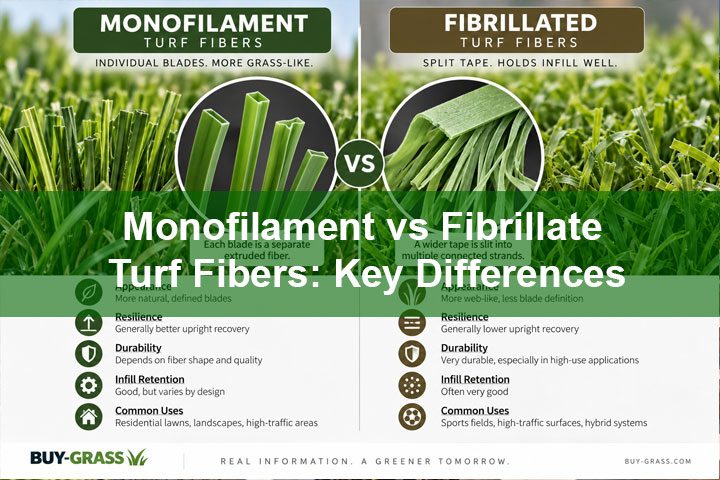
If realism matters, review our guide to artificial grass blade shapes before selecting a product.
Color
Some architectural committees want artificial grass to resemble healthy natural turf commonly found in the neighborhood. Extremely dark, neon-green, or unusually uniform products may draw unwanted attention.
Edging
Edges are one of the easiest ways to spot a poor installation. HOAs may require defined borders using concrete curbing, pavers, landscape edging, or planting beds.
Drainage
A turf installation should not redirect water toward neighboring properties, sidewalks, foundations, or common areas. The turf backing and the base beneath it should work together as a drainage system.
Overall Landscape Design
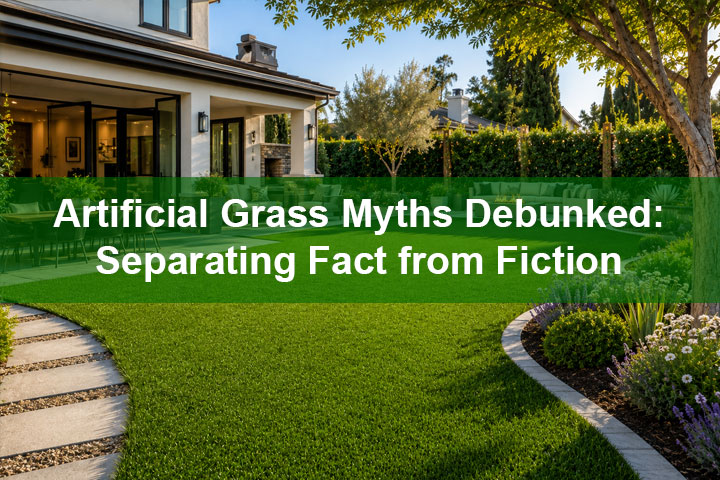
A front yard made entirely from synthetic turf can look less natural than one combining turf with shrubs, trees, decorative rock, mulch, or drought-tolerant plants.
Which Turf Choices Are Most HOA-Friendly?
| Turf or Design Choice | HOA Friendliness | Why |
|---|---|---|
| Bright single-color turf | Low | Can look noticeably synthetic |
| Multi-tone turf with thatch | High | More closely resembles natural grass |
| Very tall, ultra-plush turf | Medium | May look less like a maintained front lawn |
| Medium pile residential turf | High | Usually offers a realistic freshly-mowed appearance |
| Turf covering nearly the entire yard | Medium | May lack visual variety |
| Turf with planting beds and hardscape | High | Creates a more intentional landscape design |
Buy-Grass Pro Tip
If you’re comparing two turf samples for a front yard, don’t automatically choose the greener one. Ask which product would look most believable to someone walking past the house from 30 feet away.
How to Get HOA Approval
The approval process is usually much easier when the architectural committee receives enough information to understand exactly what the finished project will look like.
Before submitting your request, assemble as much of the following as possible:
- Current photographs of the yard
- A simple landscape drawing
- The turf manufacturer’s specification sheet
- A physical turf sample if requested
- Photographs showing the proposed turf installed elsewhere
- Edging details
- Drainage information
- Descriptions of shrubs, trees, rock, mulch, or other landscape materials
HOA Approval Checklist
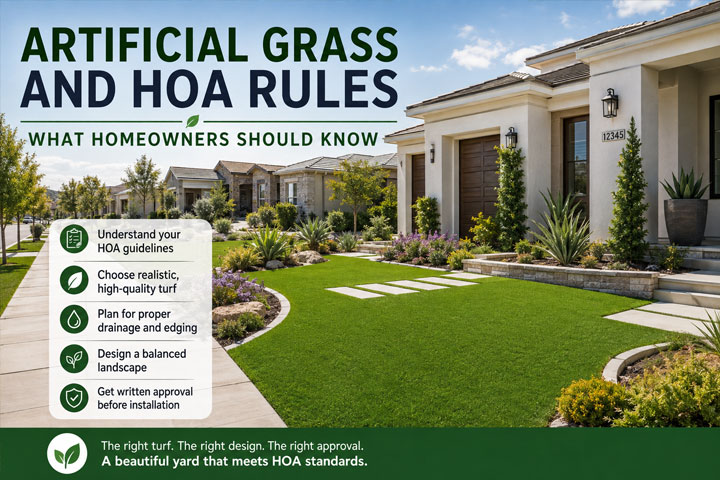
- Review your CC&Rs
- Review architectural and landscaping guidelines
- Confirm whether approval is required
- Select the proposed turf product
- Prepare a basic landscape plan
- Include drainage and edging details
- Submit product specifications or samples
- Wait for written approval before ordering materials
- Keep the approval documentation for your records
Things We Wish Every Homeowner Knew
1. Approval is easier when the board can visualize the finished yard.
A product name and a square-footage estimate may not tell the architectural committee very much. A simple drawing, photos, and a turf sample make the decision easier.
2. The most expensive turf isn’t automatically the most HOA-friendly.
A very tall, ultra-plush product may cost more but look less like a traditionally maintained residential lawn.
3. Your installer should know that the project is in an HOA community.
Tell the installer before the estimate is prepared so required edging, drainage, and design details can be incorporated from the beginning.
4. Front-yard turf and backyard turf don’t necessarily need to be the same product.
A front lawn may prioritize realism and architectural consistency, while a backyard may prioritize softness, pets, children, or entertaining.
5. Don’t assume your neighbor’s approval automatically applies to you.
Guidelines change, individual projects differ, and prior approval of another property is not necessarily approval of your proposed design.
California Homeowners Have Additional Considerations
California has enacted laws intended to support water-efficient landscaping and limit certain restrictions on drought-tolerant landscape choices. Artificial grass can fall within those conversations, but homeowners should not interpret state policy as permission to ignore HOA architectural procedures.
An HOA may still establish reasonable rules concerning appearance, installation quality, drainage, and landscape design.
Because statutes and association rules can change, homeowners should verify current requirements before relying on older advice. The Davis-Stirling Common Interest Development resource is a useful starting point for California HOA information.
Should You Cover the Entire Front Yard with Turf?
Sometimes—but we wouldn’t automatically recommend it.
A large uninterrupted turf area can look clean and attractive, but mixing synthetic grass with other landscape materials often produces a more sophisticated result.
Consider combining artificial grass with:
- Drought-tolerant shrubs
- Native plants
- Small trees
- Decorative gravel
- Mulch
- Stone borders
- Paver walkways
This approach also gives the landscape texture and seasonal interest that turf alone cannot provide.
Common Mistakes That Can Cost You Money
Ordering Turf Before Approval
This is probably the easiest mistake to avoid. If the board requests a different color, pile height, border, or landscape treatment after you’ve already purchased the materials, the cost of changing course can be significant.
Submitting Too Little Information
An incomplete application creates uncertainty. Give the architectural committee enough information to confidently understand the final result.
Buying Turf Based Only on Price
The cheapest turf may work perfectly in some applications, but a front lawn in a regulated community is probably not the place to prioritize price above realism.
Ignoring the Base and Drainage
The grass is the visible part of the project, but the base underneath it often determines whether the installation remains flat, stable, and properly drained.
See our artificial grass installation guide for more information about what’s happening underneath the turf.
Before You Buy
Don’t buy artificial grass because someone told you it’s “maintenance free.”
Artificial grass still needs occasional cleaning, brushing, and debris removal.
Buy it because reducing irrigation, mowing, fertilizing, muddy areas, or repeated lawn repairs would genuinely improve how you use your home. Those are stronger reasons—and they usually lead to happier homeowners.
Our Recommendation
If this were our own front yard in an HOA community, we’d prioritize realism, installation quality, and landscape integration over maximum pile height or the lowest possible price.
We would choose a natural-looking multi-tone turf, keep some planting beds or architectural landscaping, make sure the drainage design is clearly documented, and obtain written approval before spending money on materials.
We would also resist the temptation to buy the most luxurious-looking sample in the showroom simply because it feels softer. Front-yard artificial grass has a different job than backyard turf. Its primary job is to look believable, complement the home, and maintain curb appeal.
Continue Learning
- Artificial Grass Blade Shapes: Choosing the Right Turf
- Artificial Grass Face Weight Explained
- Pile Height vs. Performance
- Artificial Grass Installation Guide
- How Long Does Artificial Grass Really Last?
Still Not Sure Which Turf Is Right for Your Home?
Start with the way your yard will actually be used. Do you have dogs? Children? A pool? An HOA? Heavy foot traffic? A specific budget?
Those questions are more useful than simply asking which artificial grass is “best.”
Buy-Grass.com helps homeowners compare turf based on real-world needs, tradeoffs, and long-term value—not just marketing claims.